

How many months of the year can your terrace really be used? The question may seem simple, but it contains something deeper: a terrace doesn´t exist only when the weather allows it to be used. Its potential is there all year round, even though certain conditions — wind, rain, cold or heat — may limit that potential.
The question, then, isn´t how to fight the weather, but how to change the conditions under which the space can be used. This is where glazed enclosures for the hospitality sector come in.
These bespoke solutions can transform an open terrace into a space capable of adapting to different conditions, while maintaining its connection with the outdoors.
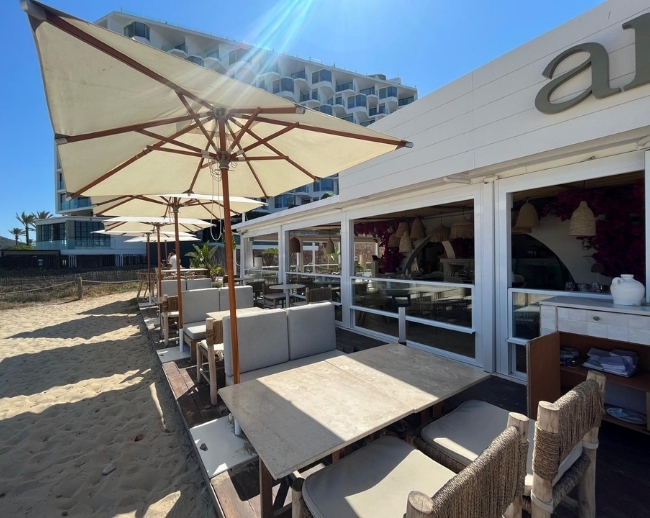
Terrace shouldn´t have a Season
In the hospitality industry, the terrace is one of the most valuable spaces and, paradoxically, one of the most dependent on circumstances that the establishment can´t control.
A windy day can completely change the experience. An afternoon of rain can leave tables empty. A drop in temperature can make a perfectly usable space suddenly impractical. The enclosure introduces a new variable: adaptability. The terrace no longer depends exclusively on favourable outdoor conditions. It can remain open when the weather is good and be protected when conditions change. In this way, the outdoor space no longer must be seasonal. It can become an effective extension of the establishment for a much greater part of the year.
And here is something that is often overlooked: comfort also has economic consequences.
A customer who feels comfortable stays longer. They may come back. They may recommend the establishment. Comfort is not simply an aesthetic consideration; it is part of the experience and, therefore, part of the relationship between the customer and the space.
What Happens When Conditions Change
Expanding an establishment isn´t always necessary to increase its capacity. Sometimes, it´s enough to make an existing space usable under a wider range of conditions. When a restaurant terrace is enclosed with glass, it gains a certain degree of independence from the weather. Wind and rain no longer determine entirely when the space can be used and when it must remain empty. But the transformation doesn´t end there. A well-designed enclosure helps maintain more stable interior conditions, reducing the need to rely constantly on heating or ventilation systems. This can have a direct impact both on operating costs and on energy consumption.
It also changes the relationship between the space and its surroundings. Acristalia systems are made to measure, adapting to the dimensions, requirements and characteristics of each terrace. It isn´t simply a matter of installing an enclosure, but of finding a configuration that responds to the specific conditions of each location.
And the more precisely the solution adapts to the space, the less necessary it becomes to impose a solution upon it. The enclosure becomes part of the space itself.
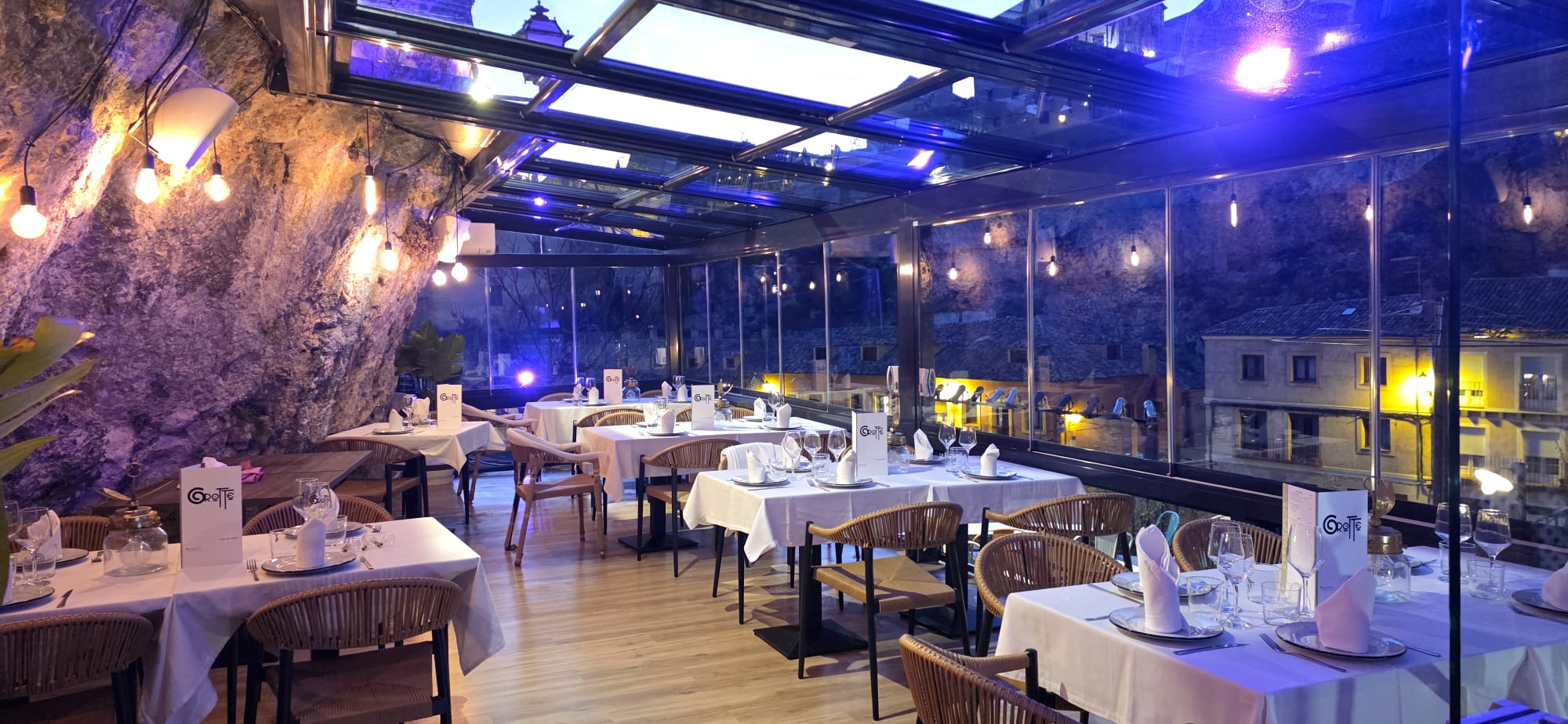
The Systems Most Requested by Hospitality Professionals
At Acristalia, we understand the specific requirements of the hospitality industry because those requirements have shaped the development of our systems. It isn´t a question of adapting a generic product to a restaurant after the fact. It’s about designing solutions from the outset for spaces that change, welcome customers, need to operate for many hours and must respond to different conditions. Among the solutions most in demand are three particularly representative systems.
Vertical Sliding System: Open and Close Without Losing the Outdoors
The Vertical Sliding System allows the glass panels to move vertically until they disappear when outdoor conditions permit. Its minimal framing creates a light visual appearance, turning the enclosure into an almost imperceptible boundary between indoors and outdoors. One particularly interesting feature is the choice between top or bottom panel storage.
Two configurations that change the way the space is used and allow the system to be adapted to the needs of each establishment. This is why it is particularly popular in beach bars, elevated terraces and establishments where the surrounding landscape forms part of the experience. Because in some restaurants, customers don´t come simply to eat. They also come to look.
Panoramic Sliding System: When Glass Expands the Space
The panoramic sliding system offers another way of relating to the outdoors. Its large glass panels slide laterally and stack at one end, allowing the entire available area to be opened when the enclosure isn´t required. The absence of vertical framing enhances the sense of visual continuity, allowing natural
light and the surrounding environment to become part of the space. It is particularly suitable for street-level terraces, hotels and establishments looking to combine protection, spaciousness and a distinctive aesthetic identity. Glass therefore ceases to act merely as a barrier. It becomes an element that preserves the feeling of being outdoors, even when the space is enclosed.
Retractable Glass Roof: Protection Without Losing the Sky
The retractable glass roof introduces a solution from above. The panels can be opened or closed according to the conditions at any given moment, providing protection from rain and cold without sacrificing natural light or the view of the sky. At Acristalia, two configurations are available:
- The Minimalist Series reduces the presence of horizontal framing as much as possible and provides enhanced protection against wind and water.
- The Panoramic Series, on the other hand, eliminates horizontal framing altogether, further reinforcing the sense of continuity with the sky and the surrounding environment. And this is precisely where combining different systems becomes particularly meaningful.
A retractable roof combined with lateral sliding systems or a guillotine enclosure can transform an open terrace into a fully protected space which, paradoxically, still retains the feeling of being outdoors.
The Terrace as an Adaptable System
Perhaps the main advantage of a glazed enclosure isn´t simply that it allows you to close a terrace. It is that it allows you to change the conditions of the space without changing its nature. Open or closed. Protected or connected to the outdoors. Sun or rain. The terrace no longer responds to a single situation. It becomes capable of responding to many. And here we arrive at an idea that can be expressed in pretty simple terms: the usefulness of a space depends not only on how it has been built, but also on its ability to adapt to the conditions around it. The aim isn´t to eliminate uncertainty from the outdoors. It is to learn how to live with it.
At Acristalia, we have been creating unique spaces with our glass enclosure systems for more than 18 years. Discover our full range of terrace solutions and transform your outdoor space into a place that can be enjoyed all year round. Tell us what you want to achieve with your terrace, and we will put you in touch with a professional in your area who can make it happen.
