

There are homes, businesses and restaurants where the temperature remains remarkably stable throughout the year. The apparent simplicity of this stability hides a more complex reality: good insulation is not the absence of change, but the ability to regulate it. A well-designed glazed enclosure creates a boundary between two environments. It does not eliminate the conditions outside; rather, it modifies the way in which those conditions influence the space within. In this sense, the enclosure becomes a thermal interface, allowing an outdoor area to become part of the usable living environment throughout the year. But this behaviour does not depend on the enclosure alone.
The type of glass is one of the fundamental variables
Different types of glass respond differently to temperature, solar radiation, weight and insulation requirements. Understanding these differences is therefore essential to understanding how the system itself will behave.
Not every glazed enclosure can accommodate every type of glass. Each system is designed around particular physical conditions, and the glass becomes part of that equilibrium. Its thickness and composition influence thermal performance, weight, insulation and, ultimately, the degree of comfort that the enclosure can provide.
Single Glass
Single glass is the lightest and most versatile option within glazed enclosure systems. Its reduced thickness makes it particularly well suited to systems designed to be handled easily and with minimal effort, such as frameless glass enclosures, panoramic sliding systems and windbreaks. These are systems designed to be opened and closed frequently, often by the user. The glass must therefore participate in that movement without introducing unnecessary resistance or weight. This does not make single glazing a lesser solution. It simply means that its behaviour is better suited to a particular set of conditions. The appropriate solution is not necessarily the one with the greatest amount of material or the highest degree of insulation. It is the one in which the different elements of the system remain in balance.
Double Glazing or Insulating Glass Units
Double glazing, also known as an insulating glass unit, consists of two panes of glass separated by an air-filled cavity. That cavity is crucial. It acts as a thermal buffer, reducing the transfer of temperature between the interior and exterior. The result is improved insulation and a reduction in the energy required for heating and cooling.
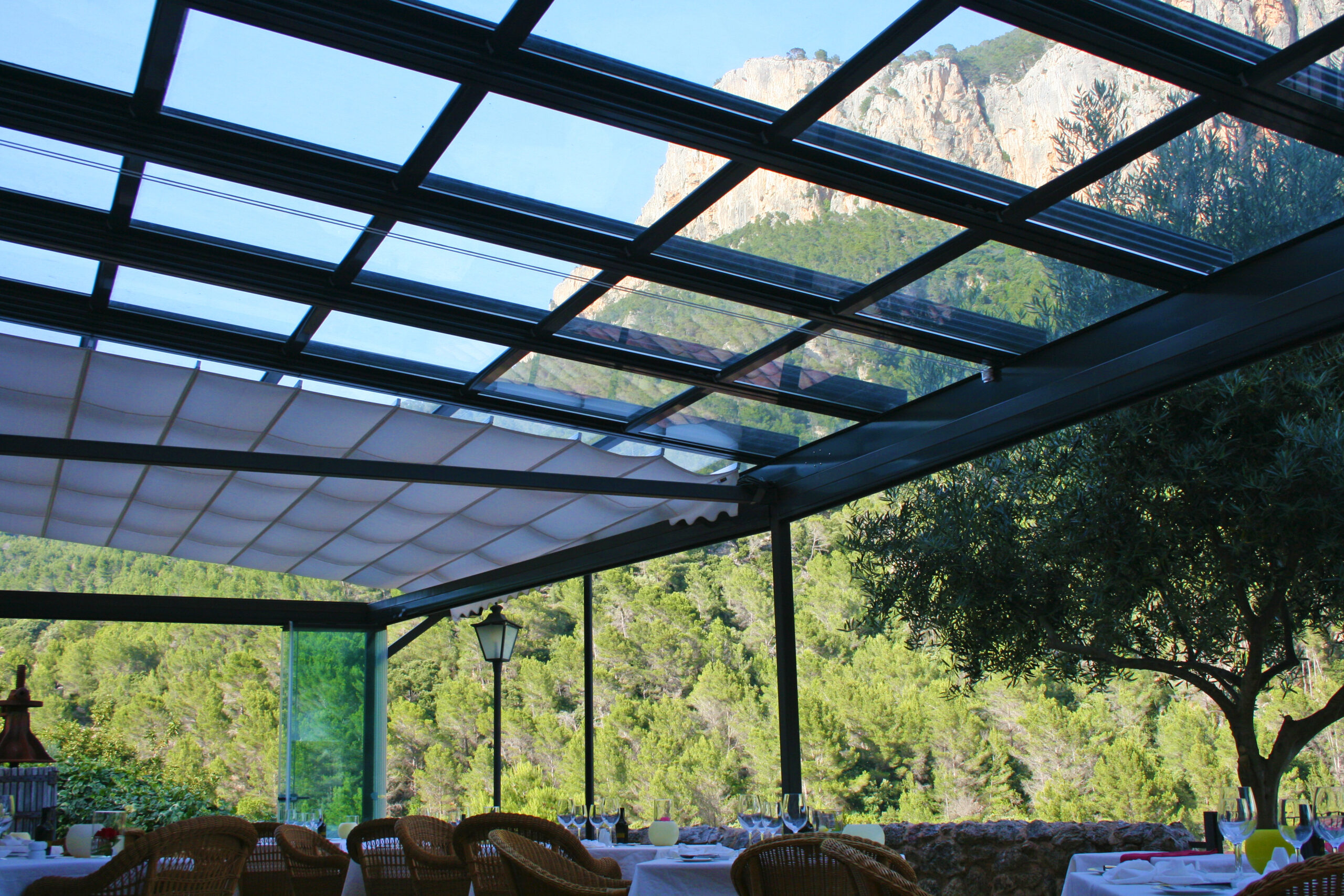
This type of glass is used in systems designed to withstand more demanding conditions, permanent enclosures or motorised opening systems, such as retractable roofs, fixed glass roofs and panoramic vertical sliding systems. In these applications, the user does not need to handle the glass directly. Opening and closing can be controlled by a remote control or mobile device, allowing larger and heavier glass panels to move with ease. Here again, the important principle is not simply that one solution is better than another. Different conditions produce different requirements.
Technical Characteristics of Glass
Choosing between single and double glazing is only the beginning. Within each category, additional treatments can modify the way the glass responds to its environment and improve its performance according to the requirements of each project.
Single glass can incorporate solar-control treatment, which reduces the amount of direct solar radiation entering the space without significantly compromising natural daylight. This can be particularly valuable on south-facing façades or terraces exposed to strong sunlight during the central hours of the day, helping to limit heat build-up and maintain a more comfortable interior environment.
The double glazing used by Acristalia incorporates Guardian Glass, a recognised name in the industry for its quality and technical performance. This type of glass can incorporate three treatments designed to modify the thermal behaviour of the enclosure. The first is solar-control glass, which we have already mentioned. It limits the amount of solar energy entering the space. The second is low-emissivity glass, which works in the opposite direction: it reduces the amount of heat escaping from the interior to the outside, improving thermal insulation. Finally, there is selective glass, which combines both principles in a single pane, controlling solar radiation while also reducing heat loss. It is the most comprehensive option for spaces that require a high level of thermal performance throughout the year.
The Right Glass for Your Enclosure, the Right Comfort for Your Space
Choosing a glazed enclosure is therefore much more than choosing a way of closing a space. The glass determines, to a significant extent, how that space will respond to winter,
summer, direct sunlight and changing weather conditions. There is no universal answer. The appropriate solution depends on the system, the way it will be used and the conditions it is expected to face. What appears at first to be a simple choice between one type of glass and another is, in reality, a question of finding the right relationship between several variables: weight, movement, insulation, solar radiation, comfort and the conditions of the surrounding environment. At Acristalia, we accompany each project with technical advice from the very beginning, helping you identify the system and glass specification that best suit your space and allow you to enjoy it under the widest possible range of conditions. Because the objective is not to eliminate change. It is to make the space capable of responding to it.
At Acristalia, we have been creating unique spaces with our glass enclosure systems for more than 18 years. Discover our full range of terrace solutions and transform your outdoor space into a place you can enjoy throughout the year
.